There is a pattern that shows up in practice more often than most people expect. A patient comes in for jaw pain, clicking, morning tension, the kind of headache that has become so familiar they have stopped mentioning it. Then, almost as an afterthought, they mention that they have been dealing with bloating for years. Or pelvic tension. Or waking up twice a night to urinate. They say it like it is unrelated. It never is. This pattern has a name: the connection between jaw clenching, pelvic floor tension, and stress. It’s not a coincidence, and understanding it changes how you treat chronic pain.
TMJ disorders affect up to 12% of the population and are twice as common in women. Yet the vast majority of treatment plans never look below the neck. That gap in care is exactly what this conversation is about.
The jaw-gut-pelvis connection is not a fringe theory. It is anatomy. And once you understand it, the way you think about chronic pain changes permanently.
Three Reasons the Jaw, Gut, and Pelvis Are Always in Conversation

The body does not experience itself in isolated compartments, even though healthcare often treats it that way. Here is why tension in the jaw reliably shows up somewhere further down the body.
Reason 1. Fascia- The Deep Front Line
The deep front line is a continuous sheath of connective tissue that runs from the jaw, through the throat, down through the diaphragm, and all the way to the pelvic floor. Restriction anywhere along that line creates tension everywhere along it. A tight jaw is not just a jaw problem. It is a pull on a chain that reaches deep into the pelvis.
Reason 2. The Shared Stress Response
The jaw and the pelvic floor are both guarding muscles. When the body perceives stress, trauma, or emotional threat, both contract together. This is a protective mechanism wired into the nervous system, not a coincidence. Releasing one area without addressing the other is like trying to unclench a fist one finger at a time.
Reason 3. The Diaphragm- The Most Overlooked Link
Jaw clenching fundamentally alters breathing mechanics. Shallow, restricted breathing impairs the natural pumping rhythm of the diaphragm, which disrupts pelvic floor coordination and gut motility. Bloating, sluggish digestion, and IBS-type symptoms in a chronic jaw clencher are rarely coincidental.
In classical acupuncture, the Stomach meridian, the Conception Vessel, and the Governing Vessel all run the full vertical axis of the body. Jaw tension interrupts qi flow along this entire axis, which is why treating the jaw can create shifts patients feel in places they never expected.
Can TMJ Cause Pelvic Floor Tension?
Yes, and the connection is more direct than most people realize.
The jaw and pelvic floor sit at opposite ends of the same fascial line, wired to the same nervous system. When the jaw stays clenched, that tension travels the length of the body, and the pelvic floor answers by tightening in return.
This is why chronic TMJ patients often describe pelvic symptoms, tightness, discomfort, a bladder that never feels settled, without realizing the two are related. They almost always are.
Both are guarding muscles. They brace together under stress and often stay braced long after the stressor has passed. Treat the jaw alone, and the tension has somewhere to return to. Treat both together, and the body finally lets go of a pattern it has been holding for years.
What Practice Has Made Impossible to Ignore?
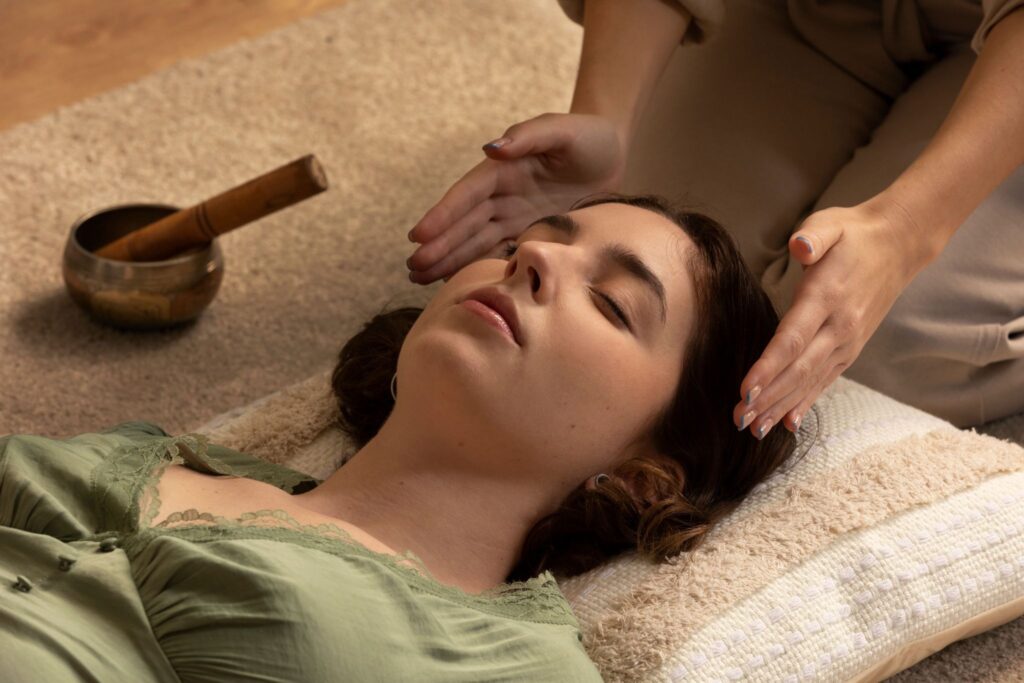
This is not a unique case. It is a pattern.
Midwives and doulas have understood a version of this for centuries. Ina May Gaskin, one of the most respected natural childbirth educators of the modern era, taught that a relaxed jaw and throat directly relaxes the pelvic floor, and used this principle to support easier labor and delivery long before fascial research existed to explain why it worked. Traditional wisdom was simply ahead of science.
From a Reiki and energy healing perspective, the body holds unresolved tension as contraction, not just physically but energetically. When the jaw finally releases in a session, there is often an immediate softening that patients describe feeling in the belly, the hips, the lower back. The body knows where it has been holding. It just needs permission to let go.
This is exactly what happened with one executive in her 40s who came to Mindful Healing Heart having been told that surgery was her only remaining option for her gallstones. In her pre-session consultation, what surfaced was not a structural problem but an emotional one that had quietly calcified over years. She had spent a long time being the responsible one, swallowing her own needs, worrying constantly about doing the right thing, and agonizing over whether she had made a mistake. The gut bears the full weight of that kind of overthinking. Bloating, anxiety, people-pleasing, and a persistent dread of getting something wrong, her body had been recording all of it. The gallstones were not random. They were her body’s honest account of years of undigested tension stored along the exact jaw-gut-pelvis axis described above. Through acupuncture and guided breath work, she released not only the physical tension but the belief system that had been generating it. She left lighter in her body and restructured how she understood the relationship between what she carried emotionally and what her body had been holding in response.
Where to Start When You Suspect the Connection

A few practices can begin to shift the pattern without waiting for a clinical appointment.
The jaw rest position is one of the most underestimated daily habits available. Tongue gently resting on the roof of the mouth, lips closed, teeth slightly apart, breathing through the nose. Most people discover they have been clenching their teeth for hours without realizing it. Breaking that pattern during the day changes what the nervous system does at night.
Four-count diaphragmatic breathing, a slow inhale expanding the abdomen, a slow exhale releasing fully, directly relaxes both the jaw and the pelvic floor at the same time. It is not a relaxation technique. It is a nervous system reset that works on the entire fascial chain simultaneously.
Yoga poses that address the full vertical axis also support this work: pigeon pose, deep squats, spinal twists, and neck stretches all create length through the deep front line and invite the jaw-to-pelvis tension to release together rather than one piece at a time.
That said, chronic or complex cases involving pelvic pain, incontinence, or persistent gut dysfunction deserve a proper clinical assessment. Self-care is a bridge, not a destination.
The Body Has Always Known What We Are Only Now Mapping
Jaw pain has spent too long being treated as a dental problem, a stress problem, or simply something to manage. It is a signal from a connected system, one that runs from the roof of the mouth to the pelvic floor, asking for whole-body attention.
At Mindful Healing Heart, every session starts with that wider view. Not just where the pain is, but where it came from, what it is protecting, and what the rest of the body is doing in response.
If you have been dealing with jaw symptoms alongside things that seem unrelated, digestive tension, pelvic discomfort, breathing that never feels quite full, those connections are worth exploring properly.
Book a consultation and bring the whole picture. That is exactly where this kind of work begins.
Frequently Asked Questions
The connection runs through three overlapping systems. Fascia physically links the jaw to the pelvic floor through continuous connective tissue. The nervous system wires both as co-guarding muscles that brace together under stress. And jaw clenching disrupts the diaphragm’s natural rhythm, impairing gut motility and pelvic floor coordination. These are not separate problems sharing a body. They are one problem expressing itself in multiple places.
In practice, yes, and consistently enough that it is no longer surprising. When jaw tension is addressed through acupuncture and nervous system work, patients frequently report improvements in pelvic symptoms they had stopped connecting to anything else. Releasing the fascial line and calming the co-guarding stress response creates shifts throughout the whole chain, not just at the treatment site.
Acupuncture works along meridian channels that run the full vertical axis of the body. The Stomach meridian, the Conception Vessel, and the Governing Vessel all travel from the jaw through the abdomen and into the pelvis. Needling key points along this axis addresses tension at multiple levels simultaneously rather than treating each symptom in isolation.
Because the nervous system designed both responses together. The jaw and pelvic floor are protective muscles that brace under stress, emotional tension, or perceived threat. Over time, if the body stays in a low-level state of alert, both areas stay in a low-level state of contraction. That is why addressing the nervous system itself, not just the muscles, is central to lasting relief.
The average client choose between:
3 Soul Mind Body Makeover 3 x 800 = 2400 (cheaper and faster)
Or
30 Reiki infused acupuncture 260 + 150×29 = $4610 (more money and more time)
Some patients notice shifts within 2 to 3 sessions, particularly when jaw tension is the primary driver. Chronic or complex cases involving longstanding pelvic symptoms or gut dysfunction may require more sessions. Improvements often appear in unexpected places first. A patient treating jaw pain may notice their digestion has eased or their sleep has deepened. The body responds in the order it is ready, not the order we expect.