Snapshot
Acupuncture during pregnancy is generally regarded as low risk when performed by a licensed acupuncturist trained in prenatal care, with certain points avoided and the provider informed of the pregnancy. Research suggests it may help with nausea and some pregnancy-related pain. It should always be coordinated with an OB or midwife, especially in higher-risk pregnancies.
- Generally considered low risk with a qualified, prenatal-trained practitioner
- May help with nausea, back/hip/pelvic pain and stress
- Evidence for breech-turning centers mainly on moxibustion, not acupuncture alone, and is still limited
- No reliable evidence it can induce labor
- Always tell your OB or midwife, and coordinate care if the pregnancy is higher-risk
Is Acupuncture Safe During Pregnancy?

If you’re considering acupuncture during pregnancy, it’s completely natural to want to know whether it’s safe for you and your baby. The reassuring news is that acupuncture is generally considered low risk when performed by a licensed acupuncturist with specific training in prenatal care. Your practitioner should know you’re pregnant before your session begins, as certain acupuncture points are avoided during pregnancy and your positioning may need to be adjusted as your body changes.
Research offers some reassurance, too. A 2014 systematic review published in Acupuncture in Medicine examined 105 trials involving acupuncture during pregnancy. Across these studies, the overall rate of adverse events was 1.9%, while 1.3% of treatments involved effects considered possibly, probably, or certainly related to acupuncture itself. Most of these effects were mild.
The National Center for Complementary and Integrative Health (NCCIH) also provides guidance on the safety and effectiveness of acupuncture, helping people make more informed decisions about their care.
Of course, every pregnancy is different, and what feels right for one person may not be suitable for another. Before booking your first session, talk to your OB-GYN or midwife, especially if your pregnancy is considered high-risk. Having that conversation beforehand can help you understand whether acupuncture is appropriate for you and how to approach it safely.
When Can You Start Acupuncture in Pregnancy?
There isn’t a single week that applies across the board, and a responsible practitioner will want to know your full history before deciding together when to begin. Many practitioners take extra care in the first trimester specifically, with lighter treatment and more conservative point selection. It’s worth asking directly what that first-trimester approach looks like before booking, so you know exactly what to expect.
What Prenatal Acupuncture Is Commonly Used to Support
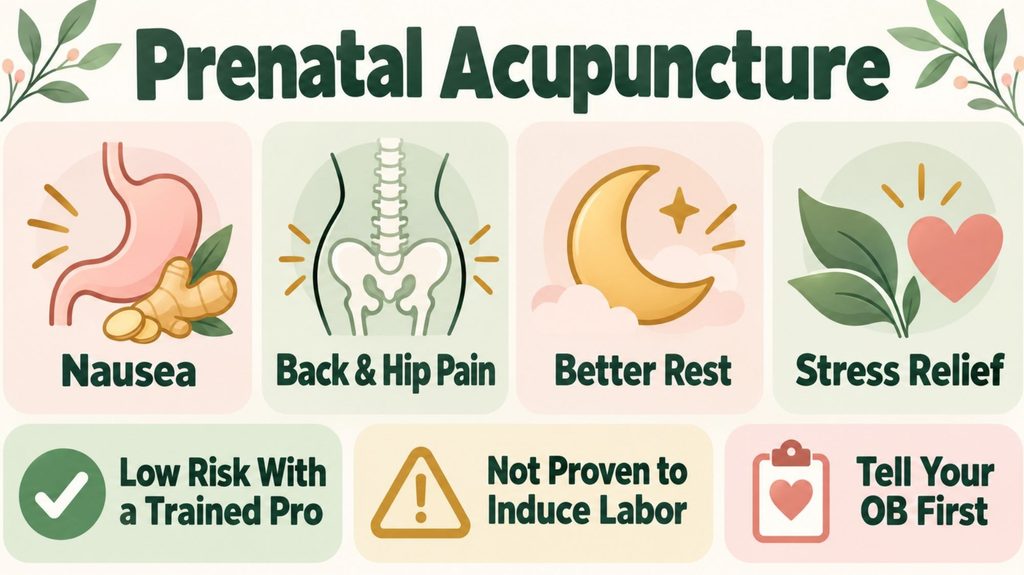
Pregnancy brings so many changes, sometimes all at once. From morning sickness to those aches that make getting comfortable a little harder, your body is working overtime. If you’re looking for ways to feel more comfortable during this time, prenatal acupuncture may be worth exploring. Research is still developing, and results vary, but some women use it alongside other forms of pregnancy care to help manage common discomforts.
- Nausea and morning sickness. If nausea has been making your mornings (or afternoons) difficult, you’re certainly not alone. Research suggests that acupuncture may help ease pregnancy-related nausea and vomiting when used alongside standard care, although the evidence isn’t conclusive. One commonly used point, called Neiguan or P6, is located on the inner wrist. It’s a traditional acupuncture point that practitioners may use to help manage nausea, but it isn’t a guaranteed remedy.
- Low back, hip, and pelvic pain. As your baby grows, your posture changes and your body carries weight differently. It’s no surprise that your back, hips, and pelvis may start feeling the strain. Acupuncture may offer some relief for certain types of pain and can be explored alongside other supportive approaches recommended by your healthcare provider.
- Sleep and fatigue. Between physical discomfort, frequent bathroom trips, and a mind that doesn’t always switch off, getting a good night’s rest can be challenging during pregnancy. Some women find acupuncture relaxing and feel it helps them unwind, though individual experiences vary.
- Stress and anxiety. Pregnancy can bring a mix of excitement, uncertainty, and worry, even when everything is progressing well. Making time to slow down and care for yourself matters, too. Acupuncture may be one part of a broader approach to managing stress, alongside other forms of emotional support that work for you. If you’ve been through a longer journey to pregnancy, you may also find our guide to fertility and stress support helpful.
Every pregnancy is different, so what feels helpful for one person may not work the same way for another. Think of acupuncture as a possible addition to your care, rather than a guaranteed solution, and check with your OB-GYN or midwife before getting started.
A Trimester-by-Trimester Guide to Prenatal Acupuncture
Every stage of pregnancy brings something new, from early morning sickness to the aches and discomforts that come with your growing bump. If you’re considering acupuncture, here’s how it may fit into your care throughout each trimester.
First Trimester: Supporting You Through Early Pregnancy
The first few months can bring nausea, fatigue, and plenty of new emotions as you adjust to pregnancy. Acupuncture may help some women manage nausea and find moments of relaxation during this time. Practitioners also take extra care when selecting acupuncture points during early pregnancy.
Second Trimester: Finding Relief as Your Body Changes
As your baby grows, you may start noticing more back pain, hip discomfort, or changes in your sleep. Acupuncture may offer support for certain types of pain and help you feel more comfortable as your body adapts. Sessions can be tailored to your concerns and how you’re feeling at this stage.
Third Trimester: Making Space for Comfort and Relaxation
The final months can bring pelvic pressure, backaches, difficulty finding a comfortable sleeping position, and the general heaviness of late pregnancy. Acupuncture may help with some of these discomforts and give you a quiet moment to relax before your baby arrives. Your practitioner can adapt your positioning and approach to suit your changing needs.
How Often Should You Have Prenatal Acupuncture?
There’s no single schedule that works for everyone. How often you have sessions depends on your symptoms, stage of pregnancy, overall health, and your practitioner’s recommendations. Rather than following a fixed routine, talk with your acupuncturist and OB-GYN or midwife about what makes sense for you and your pregnancy.
Preparing for Birth: Acupuncture in the Final Weeks
As your due date gets closer, you might be thinking about ways to feel more comfortable, relax, and prepare for the big day. Prenatal acupuncture may offer support with relaxation and some of the aches and discomforts that can come with late pregnancy. But when it comes to turning a breech baby or bringing on labor, it’s important to understand what the research actually tells us.
You may have heard about moxibustion, a technique related to acupuncture that involves gently warming a specific acupuncture point rather than inserting needles. Research suggests that moxibustion, when used alongside usual pregnancy care, may help reduce the likelihood of a baby remaining in a breech position at birth. However, the evidence for acupuncture alone is less consistent. These are two different approaches, so it’s important not to assume they offer the same benefits.
And what about using acupuncture to start labor? There’s currently no reliable evidence that acupuncture can induce labor on its own, so it shouldn’t be relied on for this purpose.
If your baby is breech or you’re exploring options as your due date approaches, speak with your OB-GYN or midwife about the safest next steps. They can help you understand which options may be appropriate for your situation and whether a complementary approach has a place in your care.
The goal is to help you feel supported and informed as you prepare for birth, without promises that the evidence can’t yet back up.
What a Prenatal Session Looks Like at Mindful Healing Heart

A prenatal session is adapted from the ground up: positioning changes as pregnancy progresses, since lying flat isn’t comfortable or appropriate later on, and needling is approached gently, with points chosen specifically for pregnancy. Whether Reiki is offered alongside acupuncture during pregnancy, and exactly how positioning and pacing work session to session, is worth asking about directly when you book, so you know what to expect before you arrive.
When to Check with Your OB or Midwife First
Some situations call for a conversation with your provider before starting acupuncture at all: a higher-risk pregnancy, any vaginal bleeding, a history of preterm labor or pregnancy loss, or use of blood-thinning medication. If any of these apply to you, loop in your OB or midwife before booking, not after.
And separately from that: if you experience heavy bleeding, severe abdominal pain, signs of preterm labor, a noticeable drop in fetal movement, or a severe headache with vision changes, that calls for urgent medical care right away, not an acupuncture appointment. Please call your provider or go to urgent or emergency care if anything feels seriously wrong.
How to Choose a Prenatal Acupuncturist
A few things worth checking before you book anywhere:
- Holds a current California acupuncture license
- Has specific training and experience in prenatal acupuncture, not just general practice
- Is willing to coordinate with your OB or midwife
- Offers comfortable positioning for pregnancy, like side-lying or supported positions rather than flat on your back later on
- Asks about your pregnancy history and any risk factors before the first session
If a practitioner can’t answer these clearly, that’s worth noticing.
What Many Expecting Mothers Describe
Practitioners who work with pregnant clients regularly hear a familiar pattern: someone comes in for one specific complaint, often nausea or back pain, and finds that the slower pace of the session itself, a stretch of quiet in an otherwise busy stage of life, matters almost as much as the treatment.
This is offered as a general pattern, not a specific client story or promised outcome. Every pregnancy is different.
Safety and Realistic Expectations
Your comfort matters, but so does making sure you and your baby are well cared for throughout pregnancy. If you have a high-risk pregnancy, have experienced bleeding, have a history of preterm labor or pregnancy loss, or take blood-thinning medication, speak with your OB-GYN or midwife before trying acupuncture. They can help you understand whether it’s appropriate for your situation.
It’s also important to know when you need medical attention rather than a complementary treatment. Heavy bleeding, severe abdominal pain, reduced fetal movement, or a severe headache accompanied by vision changes can be warning signs that need urgent medical assessment. Please don’t delay seeking care to try acupuncture.
When it comes to what acupuncture can help with, the research is encouraging in some areas but still has its limits. There is some evidence that it may help ease pregnancy-related nausea and support comfort. Research on turning a breech baby is more promising for moxibustion used alongside usual care than for acupuncture alone. And there isn’t reliable evidence that acupuncture can induce labor.
Everyone responds differently, too. Some people may notice changes in comfort over several sessions, while others
From Conception to Postpartum
Your journey through pregnancy doesn’t begin with a positive test, and it doesn’t end when your baby arrives. If you’re exploring acupuncture as part of your care, it may be something you consider at different stages along the way.
If you’re trying to conceive, you can learn more about fertility acupuncture and acupuncture alongside IVF or IUI. You can also explore our fertility acupuncture services in Pasadena to learn more about your options.
And when your baby finally arrives, your own recovery deserves attention, too. The postpartum months bring their own physical and emotional changes, and finding the right support can help you feel more cared for as you settle into this new chapter.
Expecting and Curious? Let’s Talk
Wondering whether gentle, integrative support could be part of your pregnancy is a completely reasonable thing to be curious about, and there’s no pressure to decide anything right away. If you have questions before committing to anything, that conversation is welcome. Book a session through acupuncture in Pasadena, or text Winnie directly at 626-642-8993.
Frequently Asked Questions
Research suggests acupuncture is generally low risk during pregnancy, including the first trimester, when performed by a practitioner trained in prenatal care who takes extra precautions early on. Confirming the practitioner’s specific first-trimester approach before booking is a good idea.
It may. A 2024 meta-analysis of 24 trials and nearly 2,400 women found that acupuncture combined with standard care reduced nausea and vomiting more than standard care alone, though evidence quality varied by outcome.
This varies by trimester and by what’s going on for you specifically, so it’s best discussed directly with your practitioner rather than assumed from a general schedule.
Some practitioners offer both; it’s worth asking directly whether and how they’re combined during pregnancy at the practice you’re considering.
Yes, always. This matters even more if the pregnancy is considered higher-risk or if you’re on any blood-thinning medication.