Nervous system regulation is the body’s ability to shift out of a stress response and return to a calm, balanced state. It relies on the sympathetic system, often called fight or flight, and the parasympathetic system, often called rest and digest, working together the way they were designed to. When that balance is disrupted for too long, the body tends to let you know through tension, poor sleep, digestive changes, or a wired yet exhausted feeling that never quite lifts.
Quick answers:
- Nervous system regulation is governed by the autonomic nervous system, made up of the sympathetic and parasympathetic branches
- Common signs of dysregulation include jaw tension, disrupted sleep, digestive changes, anxiety, and fatigue
- Simple daily practices such as slow breathing, gentle movement, and vagus nerve stimulation can help support balance
- Acupuncture and Reiki are two therapies that may support this process alongside everyday habits
Introduction
Most people searching for information about nervous system regulation aren’t looking for a diagnosis, they’re looking for an explanation. They know something doesn’t feel quite right. Maybe they’re constantly tense, exhausted despite getting enough sleep, anxious for no clear reason, or living with headaches, digestive issues, jaw clenching, or chronic pain that never seems to fully resolve. It can be hard to tell whether it’s just a stressful season or a sign that the body has been stuck in survival mode for longer than it should.
Stress affects far more than our thoughts. According to the American Psychological Association, a majority of adults report experiencing physical symptoms related to stress on a regular basis. That reflects what many people discover firsthand: the nervous system influences nearly every part of the body, from sleep and digestion to pain, hormones, immunity, and emotional well-being.
At Mindful Healing Heart, Dr. Winnie Chan Wang believes many chronic symptoms begin to shift when the nervous system feels safe enough to move out of protection mode and into a state of rest, repair, and healing. This guide explores what nervous system regulation actually means, common signs that your body may be asking for support, simple ways to calm your stress response, and how personalized acupuncture, Reiki, and Traditional Chinese Medicine can become part of a whole-person approach to restoring balance and resilience.
What Does Nervous System Regulation Actually Mean?
The autonomic nervous system runs quietly in the background of everything the body does. It manages heart rate, digestion, breathing, and the countless small adjustments the body makes without ever asking permission. Two branches carry most of that work.
The Sympathetic and Parasympathetic Systems, Explained Simply
The sympathetic system is the one that mobilizes energy. It responds to a deadline, a difficult conversation, or a genuine threat by increasing heart rate and preparing the body to act. It is not the enemy. It exists for good reason and serves an important protective role.
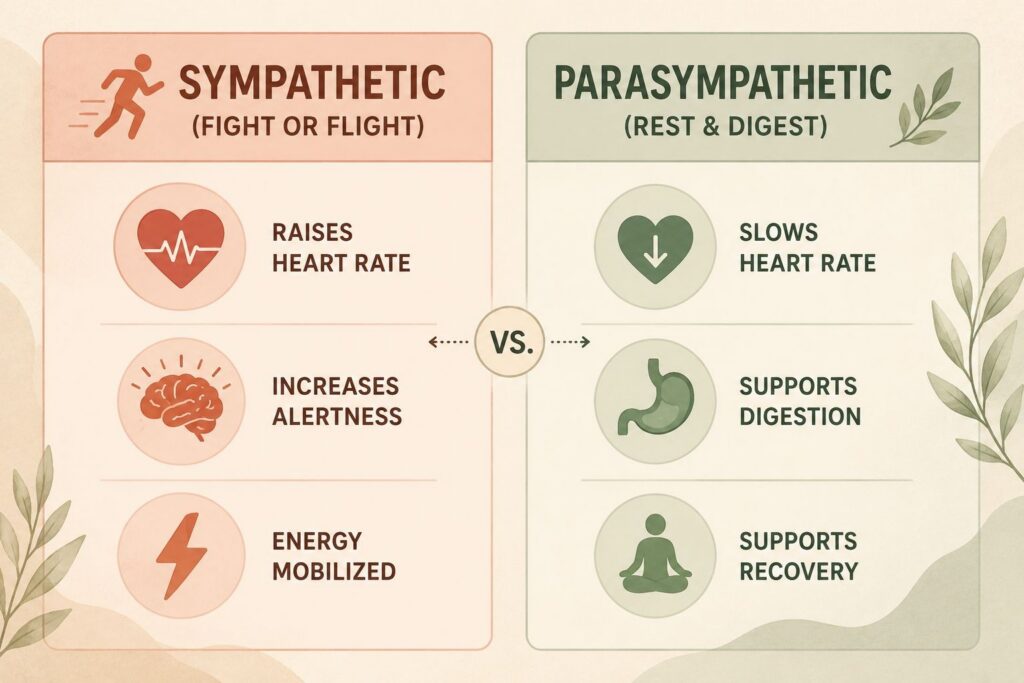
The parasympathetic system does the opposite work. It slows the heart rate, supports digestion, and allows the body to rest and repair. A well regulated nervous system moves between these two states with some ease, activating when needed and settling back down once the demand has passed.
Trouble tends to show up when the body gets stuck rather than when it activates at all. Chronic stress, long stretches without recovery, and the steady pace of modern life can leave the sympathetic system running longer than it was ever meant to, making the return to calm feel increasingly out of reach.
What Is Polyvagal Theory?
Polyvagal Theory, developed by neuroscientist Dr. Stephen Porges, offers one framework for understanding how the nervous system responds to the world around us. Beyond the familiar “fight-or-flight” and “rest-and-digest” responses, it proposes a third state, one of safety, connection, and social engagement. According to this theory, when we feel safe, our nervous system is better able to support healing, digestion, emotional regulation, and healthy relationships.
While Polyvagal Theory has influenced many clinicians working in trauma, mental health, and integrative medicine, it remains an area of ongoing scientific discussion and is best understood as one helpful framework rather than established scientific consensus. Even so, its central idea resonates with many people’s lived experience: feeling safe, in our bodies, our relationships, and our environment, can make it easier for the nervous system to settle and for the body to move toward healing. At Mindful Healing Heart, Dr. Winnie Chan Wang incorporates this understanding alongside Traditional Chinese Medicine and modern neuroscience to support whole-person care that helps the body shift from chronic stress toward greater balance and resilience.
What Are the Signs of a Dysregulated Nervous System?
The signals are rarely dramatic all at once. More often, they build slowly and get mistaken for personality traits or simply the cost of being busy. Common signs include:
- Jaw clenching or tension around the TMJ
- Digestive changes that do not have a clear cause
- Trouble falling asleep or staying asleep through the night
- A wired but tired feeling, or anxiety that feels disproportionate to the moment
- Fertility or hormonal irregularities
- Unexplained fatigue or ongoing brain fog
None of these signs point to a single cause, and that is precisely the point. A nervous system under sustained strain tends to affect several systems in the body at once rather than staying contained to one. Someone dealing with jaw tension may also notice their sleep has grown lighter. Someone managing digestive discomfort may also be navigating hormonal shifts that seem unrelated on the surface but often are not. Looking at these patterns together, rather than one symptom at a time, is often where a clearer picture begins to form.
Why Nervous System Regulation Is More Than a Breathing App
Breathing exercises and grounding techniques genuinely help, and they belong in almost anyone’s toolkit. At the same time, a body that has been carrying chronic tension for months or years often benefits from support that works with the nervous system more directly, rather than relying on willpower alone to override it.
How Acupuncture May Support the Vagus Nerve and Nervous System
Acupuncture uses very fine, sterile needles placed at carefully selected points to support the body’s natural healing and regulatory processes. In Traditional Chinese Medicine, this is understood through the movement of Qi along the body’s meridian system, a framework that has guided clinical practice for thousands of years and is distinct from modern Western physiology. Contemporary research, meanwhile, is exploring how acupuncture may influence the nervous system, including pathways involving the vagus nerve, the autonomic nervous system, and the body’s stress response. Although this research is still evolving and the exact mechanisms have not been fully established, the findings are encouraging.
Many people notice a shift during treatment without needing to understand the science behind it. Breathing becomes slower, muscles begin to soften, and the mind grows quieter as the body settles into a more relaxed state. At Mindful Healing Heart, Dr. Winnie Chan Wang combines personalized acupuncture with Reiki to support nervous system regulation and whole-person healing. If you’d like to learn more about what to expect during treatment, visit our Acupuncture in Pasadena page.

How Reiki Supports the Body’s Shift Toward Rest and Recovery
Reiki is a gentle practice that uses light touch or hands held just above the body to create a calm, supportive environment for relaxation. Rooted in the traditional concept of energy balancing, Reiki offers a perspective that is distinct from Western physiological models. While its exact mechanisms are still being studied, some research suggests Reiki may help reduce perceived stress and promote a greater sense of well-being for some individuals.
Many people describe feeling their breathing slow, their muscles soften, and their minds become quieter during a session, making it easier for the body to shift from a state of chronic stress toward one of rest and recovery. At Mindful Healing Heart, Dr. Winnie Chan Wang often integrates Reiki with acupuncture to support nervous system regulation and whole-person healing. To learn more about what Reiki is and what to expect during a session, visit our Reiki page.
A Simple At Home Nervous System Regulation Practice to Try Today

This breathing technique can be practiced almost anywhere and takes only a few minutes.
- Sit or lie down somewhere comfortable and place one hand gently on the belly.
- Inhale slowly through the nose for a count of four, letting the belly rise.
- Hold briefly for a count of one or two.
- Exhale slowly through the mouth for a count of six, allowing the exhale to be longer than the inhale.
- Repeat for five to ten rounds, noticing any small shift in the shoulders, jaw, or breath as the practice continues.
A longer exhale relative to the inhale tends to support the parasympathetic system, which is part of why this simple pattern can feel calming even after just a few rounds.
When to Seek Professional Support for Nervous System Regulation
Simple daily practices, such as mindful breathing, gentle movement, good sleep habits, and time spent in nature, can make a meaningful difference in supporting your nervous system over time. But if you’ve been living with chronic pain, persistent anxiety, insomnia, digestive issues, fertility challenges, burnout, or other long-standing symptoms, your body may benefit from more personalized support.
At Mindful Healing Heart, Dr. Winnie Chan Wang takes a whole-person approach, recognizing that the nervous system influences nearly every aspect of health. Rather than treating symptoms in isolation, she considers how stress, sleep, digestion, hormones, pain, and emotional well-being are interconnected. By thoughtfully integrating personalized acupuncture, Traditional Chinese Medicine, Reiki, and medical intuitive guidance, she helps support your body’s natural ability to regulate, heal, and restore balance.
If you’d like to learn more about this integrative approach, visit our Holistic Healing in Pasadena page to explore how these therapies work together to support long-term health and resilience.
Finding Support in Pasadena and the San Gabriel Valley
Mindful Healing Heart is located in Pasadena and welcomes clients from Altadena, Sierra Madre, Arcadia, San Marino, South Pasadena, Monrovia, Temple City, and the wider San Gabriel Valley. Dr. Winnie Chan Wang, MSOM, L.Ac., brings a background in engineering from MIT together with training in Traditional Chinese Medicine, Reiki, and medical intuitive guidance, offering a perspective that draws from both structured, systems based thinking and traditional healing practices. Every visit begins with a conversation, followed by a Traditional Chinese Medicine assessment, so that care reflects what a particular body needs rather than a standard protocol applied to everyone in the same way.
Healing rarely happens in a single visit, and that is entirely normal. It tends to begin with one conversation, one session, and a willingness to listen to what the body has been trying to communicate all along. For those in Pasadena or the surrounding San Gabriel Valley who are ready to explore what regulation and balance could feel like, a consultation is a gentle place to start.
Book a nervous-system-focused consultation at Mindful Healing Heart
Frequently Asked Questions
1. What is nervous system regulation?
Nervous system regulation is the body’s ability to shift out of a stress response and return to a calmer, more balanced state. It reflects the healthy coordination between the sympathetic nervous system (“fight or flight”) and the parasympathetic nervous system (“rest and digest”), allowing the body to adapt to life’s challenges and recover afterward. When the nervous system is well regulated, it becomes easier to sleep, digest food, manage emotions, think clearly, and support the body’s natural healing processes.
2. What are common signs of nervous system dysregulation?
Common signs of nervous system dysregulation include chronic muscle tension, jaw clenching or TMJ, anxiety, disrupted sleep, digestive changes, headaches, fatigue, brain fog, feeling “wired but tired,” difficulty relaxing, and becoming easily overwhelmed. These symptoms often occur together because the nervous system influences nearly every function of the body, from sleep and digestion to pain, mood, and emotional resilience.
3. Can acupuncture help with nervous system regulation?
Acupuncture may help support nervous system regulation by promoting relaxation, easing muscle tension, improving circulation, and encouraging the body to shift toward a more restorative state. Research suggests it may influence the autonomic nervous system, although the exact mechanisms are still being studied.
4. Does Reiki calm the nervous system?
Many people report feeling calmer, more relaxed, and emotionally balanced after a Reiki session. While the exact mechanisms are still being studied, some research suggests Reiki may help reduce perceived stress and promote a greater sense of well-being for some individuals.
5. How long does it take to feel more regulated?
Everyone’s nervous system is different, so the timeline varies from person to person. Some people notice subtle changes, such as feeling calmer, sleeping more deeply, or experiencing less muscle tension, within the first few sessions. For others, especially those with long-standing stress patterns or chronic symptoms, meaningful and lasting change often develops gradually over a series of treatments.