A women’s healing circle is a small, intentional gathering where women come together to slow down, reflect, listen, and support one another in a structured, non-clinical setting. Unlike therapy, a healing circle does not involve diagnosis or treatment. Unlike a casual social gathering, it typically follows shared agreements around confidentiality, respectful listening, turn-taking, and creating space for each person to be heard without interruption or judgment.
Many circles include elements such as guided reflection, breathwork, gentle movement, meditation, sound healing, journaling, or a closing ritual, depending on the facilitator and the group. The goal is not to “fix” anyone, but to create a supportive environment where women can feel seen, connected, and less alone in what they are carrying.
In short:
- Uses intentional structure and respectful turn-taking rather than open-ended conversation
- Is facilitated, but the facilitator is not necessarily a licensed therapist
- May include an opening practice, guided sharing, movement, sound, reflection, or a closing ritual
- Confidentiality is based on group agreements rather than the legal protections that apply in psychotherapy
- Supports connection, reflection, and emotional well-being
- Complements rather than replaces therapy, medical care, or mental-health treatment when those are needed
Introduction
Many women arrive at their first healing circle unsure of what to expect, and that uncertainty is completely normal. A women’s healing circle is a recurring, intentionally held gathering where women come together to slow down, reflect, and share what is genuinely present for them while others listen without interrupting, fixing, or judging. It is not therapy, and it is also more intentional than a casual social gathering. Most circles follow a gentle structure, often beginning with a grounding practice, moving into guided sharing or reflection, and closing in a way that helps the group feel settled and connected. Some circles also include breathwork, movement, journaling, meditation, or sound healing. Research on peer-support and facilitated group formats suggests that consistent participation can support emotional well-being, social connection, and quality of life for some people, which may help explain why this age-old practice continues to resonate in modern wellness spaces.
What Is a Women’s Healing Circle, Exactly?
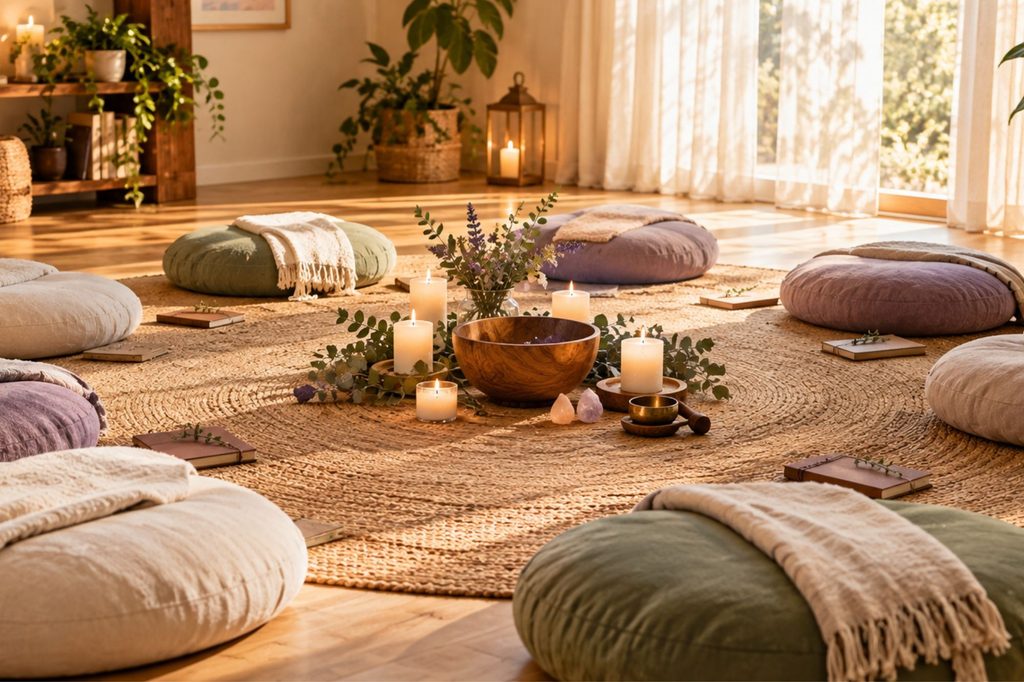
A women’s healing circle is a structured, recurring gathering where women come together to share, listen, and support one another through life transitions, stress, grief, relationships, caregiving, identity shifts, and the emotional weight that often goes unspoken. Unlike clinical therapy, the circle is not designed to diagnose or treat mental health conditions. Instead, it uses intentional practices such as guided sharing, respectful turn-taking, confidentiality agreements, reflection, breathwork, movement, or sound to create a space where each woman can feel heard without immediately being advised, corrected, or interrupted.
What makes a healing circle different from a regular girls’ night is the structure underneath the connection. Casual conversations can easily become advice-giving, cross-talk, or one person carrying most of the emotional labor. A healing circle intentionally creates a different rhythm: there is a clear beginning, a shared way of taking turns, and a thoughtful closing. That structure can make it easier to speak honestly, listen deeply, and allow experiences to be witnessed without needing to solve them.
The practice itself is not new. Structured circles for storytelling, listening, ritual, and mutual support have existed across many cultures for generations. What is newer is their return within modern yoga studios, wellness centers, and community spaces, where many women are looking for something that sits somewhere between therapy and friendship, a place for meaningful connection, reflection, and community without turning every gathering into a clinical experience.
Women’s Healing Circle vs. Support Group vs. Therapy: What’s the Difference?
Women’s healing circles, support groups, and therapy all provide valuable forms of support, but they serve different purposes. A women’s healing circle focuses on shared experience, reflection, and connection through a guided, non-clinical format. A support group is typically centered around a specific life challenge or health condition and brings together people with a shared experience. Therapy is provided by a licensed mental health professional and is designed to assess, diagnose, and treat emotional or psychological concerns using evidence-based approaches.
Many women benefit from more than one of these at different stages of life. A healing circle may offer a sense of belonging and emotional nourishment. A support group can provide understanding from others facing similar circumstances. Therapy offers individualized clinical care when deeper emotional, behavioral, or mental health concerns need professional treatment.
| Healing Circle | Support Group | Therapy | |
| Who leads it | Peer facilitator or practitioner | Peer or professional | Licensed therapist |
| Focus | Shared presence, ritual, listening | Specific shared issue, such as grief or illness | Diagnosis, treatment, clinical goals |
| Structure | Opening ritual, sharing round, closing | Agenda driven discussion | Clinical session format |
| Confidentiality | Group agreement | Group agreement | Legally protected |
| Cost | Often low cost or donation based | Varies, sometimes free | Typically higher, may be insurance covered |
| Best for | Connection, emotional release, community | Processing a specific shared experience | Diagnosable conditions, deeper clinical work |
Rather than viewing these approaches as competing with one another, it’s often most helpful to see them as complementary. The right choice depends on what you need in this season of life. If you’re looking for connection, self-reflection, and a supportive community, a women’s healing circle may be a wonderful place to begin. If you’re navigating a specific diagnosis or major life event, a support group may be the best fit. And if you’re experiencing significant anxiety, depression, trauma, or other mental health concerns, therapy remains the most appropriate setting for clinical care.
Why Are So Many Women Looking for This Right Now?
Many women are carrying an enormous invisible mental and emotional load. Between work, caregiving, children, aging parents, relationships, household responsibilities, and the constant coordination required to keep everyday life moving, there are fewer and fewer spaces where women are not responsible for someone else.
Even strong friendships can become centered around schedules, problem-solving, or supporting another person’s immediate needs. A women’s healing circle creates a different kind of space. For a set period of time, there is nothing to organize, fix, or hold together. Women are invited to slow down, speak honestly if they want to, listen without judgment, and simply be present.
That shift can be surprisingly powerful. Instead of having to perform strength or wellness, the circle offers permission to set some of the weight down. For many women, what they are looking for is not another obligation or another self-improvement project. It is a place where they can feel seen, heard, supported, and connected without having to take care of everyone else first.
Is There Actual Science Behind Group Healing?
Yes, although it’s helpful to distinguish between what is well supported by research and what comes from traditional or experiential healing practices. One of the strongest scientific concepts underlying group healing is co-regulation, the process by which our nervous systems influence one another. Research suggests that spending time with calm, attentive, and emotionally safe people can help reduce physiological stress and support a shift toward the body’s parasympathetic, or “rest and digest,” state.
Studies have also found that social connection and a sense of belonging are associated with better emotional well-being, greater resilience, and lower levels of perceived stress. While researchers continue to study the specific effects of healing circles themselves, there is growing evidence that supportive group environments, compassionate listening, and meaningful interpersonal connection can positively influence mental and emotional health.
At the same time, some elements commonly included in women’s healing circles, such as energy work or spiritual practices, are rooted in traditional or holistic healing philosophies rather than established medical science. These practices are best understood as complementary approaches that many people find personally meaningful, not as clinically proven treatments.
Together, this research helps explain why many women leave a healing circle feeling calmer, more connected, and less alone. The experience is not simply about talking, it is also about allowing the nervous system to experience the safety of being seen, heard, and supported within a caring community.
What Is Co-Regulation and Vagal Tone?
One reason women’s healing circles can feel so restorative is a process called co-regulation. In simple terms, our nervous systems respond to the people around us. Sitting with someone who is calm, attentive, and nonjudgmental can help our own breathing slow, our muscles soften, and our sense of safety increase. This isn’t mystical, it’s part of how human beings are wired to connect and support one another.
Co-regulation is closely related to vagal tone, a term that describes how effectively the vagus nerve helps the body shift from a state of stress into one of rest and recovery. Higher vagal tone is generally associated with greater flexibility in responding to life’s challenges, allowing the nervous system to recover more efficiently after periods of stress. Researchers continue to study how social connection, slow breathing, compassion, and other calming practices influence this process.
It’s also helpful to distinguish between established science and traditional healing practices. Concepts such as co-regulation, vagal tone, and nervous system regulation are active areas of scientific research. Other elements that may be included in some healing circles, such as ritual, energy work, or symbolic practices, come from traditional, cultural, or experiential healing frameworks rather than established clinical science. These approaches can be personally meaningful for many participants, while serving a different role than evidence-based medical or psychological treatments.
Research also suggests that structured group connection itself can be beneficial. For example, a published retrospective study of Talking Circles implemented within primary care found that participants who attended multiple sessions reported meaningful improvements in symptom severity, daily functioning, and overall well-being. While these findings apply to that specific program and cannot be assumed to extend to every healing circle, they add to a growing body of evidence suggesting that supportive, structured group experiences may be positive.
What Actually Happens Inside a Women’s Healing Circle?
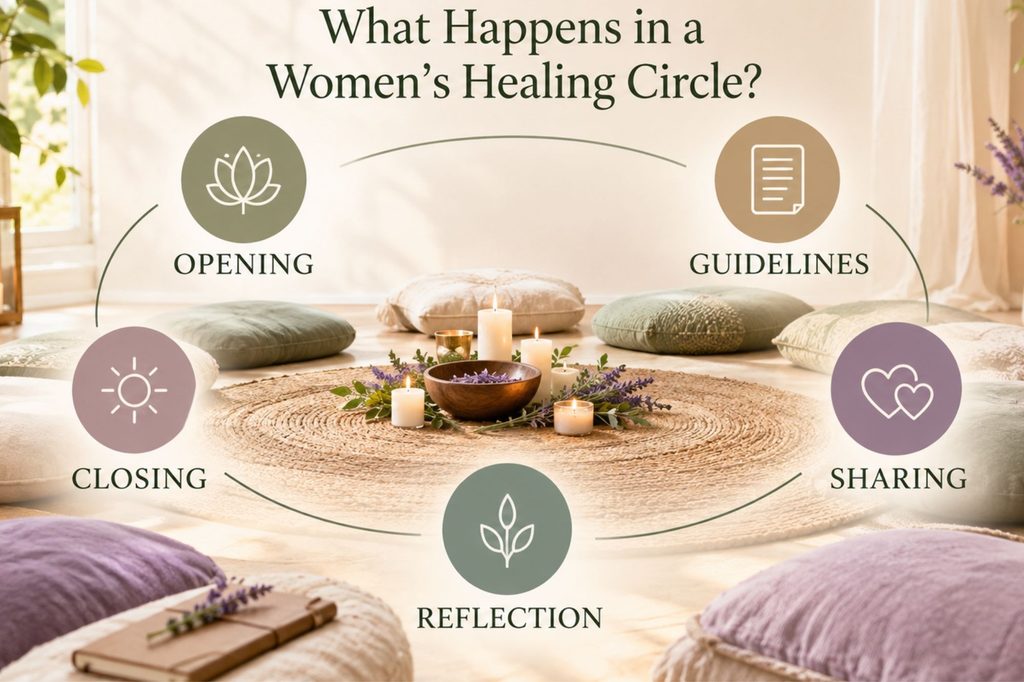
Most circles follow a simple arc: an opening to settle the group, a sharing round where each woman speaks without interruption, an optional gentle practice such as breathwork or reflection, and a closing that brings everyone back together.
The Basic Structure, Step by Step
- Opening. A brief moment of quiet, breath, or intention setting to shift out of the pace of the day and into the room.
- Guidelines reminder. Confidentiality, no cross talk, and no giving unsolicited advice while someone else is sharing.
- Sharing round. Each woman speaks in turn. Others listen without responding verbally, even when it’s tempting to jump in.
- Optional practice. This may include gentle energy work, reflection prompts, or quiet movement, offered as a complementary layer rather than a clinical treatment.
- Closing. A short reflection or small ritual that marks the circle’s end and the group’s re-entry into the rest of the day.
What tends to surprise first-timers is how little pressure there actually is. Nobody is being asked to solve anything. Nobody is expected to have a breakthrough. The structure exists precisely so that a woman can simply say what’s true for her in that moment, and be met with silence and attention instead of advice.
How Do You Know If You’re Ready for a Women’s Healing Circle?
There is no perfect moment when someone suddenly becomes “ready” for a women’s healing circle. Often, women find their way to one when they realize they have been carrying something quietly for too long and would benefit from a space where they can simply be heard.
A few signs a circle might feel supportive right now:
- You feel like you have people around you, but still wish someone truly understood what you are carrying.
- You are moving through stress, grief, caregiving, relationship changes, burnout, or another major life transition.
- You are craving a connection that feels deeper than small talk or social catching up.
- You are curious about reflection, sound healing, breathwork, or gentle holistic practices in a supportive group setting.
- You want a regular space where nothing is required of you except showing up as you are.
- You are looking for community support that complements, rather than replaces, therapy or medical care.
- You do not need to arrive with a problem to solve or a story prepared to share. Sometimes readiness is simply the feeling that it would be good to have 90 minutes where you do not have to hold everything together for everyone else.
What to Expect at Your First Session
The first session often feels more intimidating beforehand than it does once you arrive. You do not need to prepare anything to say, and there is no pressure to share before you feel ready. Many women choose to simply listen during their first circle, and passing when it is your turn is always welcome.
Wear comfortable clothing and come as you are. Depending on the space, you may sit on a chair, cushion, or mat, and some sessions may include gentle movement, breathwork, reflection, or sound healing. The most important thing is simply giving yourself permission to be present without needing to perform, explain, or fix anything.
You are always in control of how much you participate. Whether you speak openly, share only a few words, or spend most of the session quietly observing, your experience is valid. The goal is to create a space where you can feel safe, supported, and connected at your own pace.
A Practitioner’s Perspective: Why Winnie Believes in the Power of Gathering
Dr. Winnie Chan Wang’s path into healing was deeply personal. After years of chronic pain following a tailbone injury and a major health crisis that reshaped how she understood the body, she began exploring approaches that looked beyond symptoms alone. With an engineering background from MIT, she brought the same curiosity about patterns, systems, and root causes into her study of acupuncture, Reiki, and medical intuition.
Through her own healing journey and years of supporting clients in Pasadena, Dr. Winnie Chan Wang came to recognize something important: healing often feels different when it happens in community. The nervous system can respond powerfully to safe presence, shared understanding, and the experience of being witnessed without judgment. Sometimes the body softens simply because it realizes it does not have to carry everything alone.
That is why community spaces such as a women’s healing circle fit naturally alongside the one-on-one work offered at Mindful Healing Heart. Acupuncture and Reiki provide individualized support through touch, energy work, and nervous system regulation, while the circle offers something different: connection, shared presence, and the healing experience of being seen and heard by others. Neither replaces the other. For many women, having access to both personal care and supportive community creates a fuller path toward resilience, balance, and lasting well-being.
Is a Healing Circle Safe? Realistic Expectations
Women’s healing circles are generally gentle, low-risk spaces for reflection, connection, and emotional support, but it is important to understand what they are, and what they are not. A circle is not a substitute for psychotherapy, psychiatric care, medical treatment, or emergency support, and it is not designed to manage an active mental health crisis or serious medical condition on its own.
Confidentiality is typically part of the group agreement, but unlike therapy, it is not protected in the same legal or clinical way, so participants should share only what feels comfortable. A thoughtful facilitator will also be clear about the limits of the space and encourage additional professional support when someone needs care beyond what the circle can appropriately provide.
It is also normal to feel tender, reflective, or emotionally tired after a meaningful session. For many women, that settles naturally with rest, hydration, journaling, or quiet time afterward. The healthiest approach is to view a healing circle as one supportive layer of care, something that can complement existing therapy, medical care, and personal wellness practices rather than replace them.
Women’s Healing Circle in Pasadena: What’s Available Locally
Women’s Healing Circle in Pasadena: What’s Available Locally
Pasadena has a growing community of women seeking spaces for connection, nervous system support, reflection, and whole-person healing. At Mindful Healing Heart, the Midweek Healing Circle offers a warm, low-pressure place to gather, reset, and reconnect with yourself in the middle of the week.
The circle meets every Wednesday from 11:30 AM to 1:00 PM at the Awareness Center in Pasadena, with the option to join live on Zoom as well. Each 90-minute session may include heart-centered conversation, guided reflection, gentle movement, breathwork, sound healing, and practical tools for emotional well-being. There is no pressure to share more than feels comfortable.
Investment: $52 for a single session, or $38 each when you bring a new friend.
Mindful Healing Heart is located at 2801 E Foothill Blvd, Pasadena, CA 91107, inside the Awareness Center for Yoga, Meditation and Healing. For anyone who would prefer to begin with individual support before or alongside the group, a one-on-one session with Dr. Winnie Chan Wang can also be booked through Mindful Healing Heart.
Ready to Experience a Women’s Healing Circle?
Somewhere between therapy and friendship is a kind of space many women do not realize they have been missing until they experience it for themselves. A healing circle is not meant to fix everything. What it offers instead is something simpler and often deeply meaningful: a place to slow down, be heard exactly as you are, and spend time in community without having to perform, explain, or hold everything together for everyone else.
If you are in the Pasadena area and curious about the Midweek Healing Circle, or wondering whether a one-on-one Reiki or acupuncture session might be a better fit, Dr. Winnie Chan Wang would be happy to help you explore the next step. Reach out to Mindful Healing Heart to learn what is currently available and choose the kind of support that feels right for you.
Frequently Asked Questions
1. What happens in a women’s healing circle?
Most women’s healing circles begin with a brief grounding or settling practice, followed by a guided sharing round where each woman has the opportunity to speak without interruption or unsolicited advice. Depending on the circle, the session may also include breathwork, gentle movement, meditation, journaling, sound healing, or reflection. The gathering usually closes with a short ritual or moment of integration to help everyone transition back into the rest of the day.
2. Is a women’s healing circle the same as therapy?
No. A women’s healing circle is a non-clinical, community-based space focused on reflection, connection, and mutual support. It does not involve diagnosis, psychotherapy, or individualized mental health treatment. Therapy, by contrast, is provided by a licensed mental health professional within a clinical framework. Many women find value in both, using a healing circle for community and shared connection while continuing therapy for deeper clinical support when needed.
3. How is a healing circle different from a regular support group?
While both offer connection and encouragement, they are designed for different purposes. Support groups are typically centered around a specific shared experience, such as grief, cancer, addiction, or caregiving, and often focus on education, discussion, and mutual support related to that topic. A women’s healing circle is generally broader in scope, creating space for personal reflection, emotional expression, and whole-person well-being. Most circles follow a consistent structure that may include grounding practices, guided sharing, breathwork, meditation, sound healing, or a closing ritual, regardless of the specific challenges participants bring that day.
4. Do I have to share personal details at a women’s healing circle?
No. Sharing is always an invitation, never an expectation. Many women choose to simply listen during their first session, and you’re always welcome to pass when it’s your turn to speak. You are encouraged to share only what feels comfortable, at your own pace. Whether you speak, listen, or do a little of both, you are an equally valued part of the circle
5. Can a women’s healing circle help with stress or anxiety?
Many women find that participating in a healing circle helps them feel calmer, more connected, and less alone. Research on structured peer-support and facilitated group programs suggests they may improve emotional well-being and reduce perceived stress for some participants. While a women’s healing circle can be a meaningful source of support, it is not a substitute for therapy, psychiatric care, or medical treatment for anxiety or other mental health conditions. At Mindful Healing Heart, the Midweek Healing Circle is intended to complement professional care by offering a supportive community and practices that encourage relaxation, self-awareness, and nervous system regulation.