Snapshot
Facial acupuncture before and after results are typically gradual, not dramatic, and tend to build across a series of sessions rather than appear after one visit. People most commonly notice changes in puffiness, jaw and forehead tension, and overall radiance. Research is still limited, and individual results vary; it is not a substitute for Botox or fillers.
- Results are cumulative, built across a series, not an instant transformation
- Commonly noticed changes: puffiness, jaw and forehead tension, tired-looking eyes, overall radiance
- Research includes some promising small studies and at least one that found no significant change
- Not a substitute for Botox, fillers or microneedling, just a different approach with different evidence behind it
- Mild bruising or tenderness is the most commonly reported side effect
So, What Does “Before and After” Actually Look Like?

Here’s the honest answer, the one you probably came here looking for: facial acupuncture tends to work slowly and quietly, not all at once. Most people don’t walk out of a single session looking like a different person. What tends to happen instead is a gradual shift over a handful of visits, things like less puffiness, a softer look around the jaw, eyes that seem a little less tired.
A small 2013 pilot study out of Kyung Hee University Hospital followed 27 women through five sessions over three weeks and found a real, measurable improvement in skin elasticity. That’s encouraging. But it’s also worth knowing that not every study agrees. A smaller 2012 case series looking specifically at wrinkles didn’t find a significant difference after eight sessions. Both of those are true at the same time, and that’s exactly the kind of honesty this topic deserves.
How Is This Different From Botox, Fillers or Microneedling?
If you’re exploring ways to care for your skin, you’ve probably come across facial acupuncture alongside treatments like Botox, fillers, and microneedling. While they may all be part of a skincare conversation, they work in very different ways.
Facial acupuncture uses very fine needles placed at specific points on the face and sometimes the body. The aim is to support circulation, ease muscle tension, and promote overall skin wellness. Unlike cosmetic injectables and microneedling, it doesn’t work by relaxing targeted muscles, adding volume, or deliberately creating tiny punctures to trigger the skin’s repair process.
Here’s how the approaches differ:
- Botox: Temporarily relaxes specific muscles to soften the appearance of certain expression lines.
- Dermal fillers: Add volume to areas of the face to address concerns such as lost fullness or deeper folds.
- Microneedling: Creates controlled micro-injuries in the skin to stimulate its natural repair response.
- Facial acupuncture: Uses fine needles as part of a traditional acupuncture approach, with the goal of supporting skin health and overall well-being.
So, can facial acupuncture improve your appearance? There’s some early research worth exploring. A 2020 review published in Cosmetics examined seven studies and found potential benefits for skin laxity and muscle tone. However, the evidence remains limited, and more research is needed to establish how effective facial acupuncture is for cosmetic concerns.
If you’re deciding which treatment is right for you, it helps to understand what each option can realistically offer. Facial acupuncture isn’t a substitute for Botox, fillers, or microneedling, and it’s best approached with an understanding of both its potential benefits and the current limits of the evidence.
What People Actually Notice
Talk to enough people who’ve tried this, and a few things come up again and again: a bit less puffiness, especially under the eyes, less tension held in the jaw or forehead, a kind of glow that’s hard to pin down but easy to notice, and sometimes a softening of fine lines.
None of this is guaranteed. Results vary quite a bit from person to person, and the research backs that up, some studies show real change, others don’t. What seems consistent is that this works better as a cumulative thing than a one-time event.
A Realistic Timeline: One Session, a Few Sessions, a Full Series
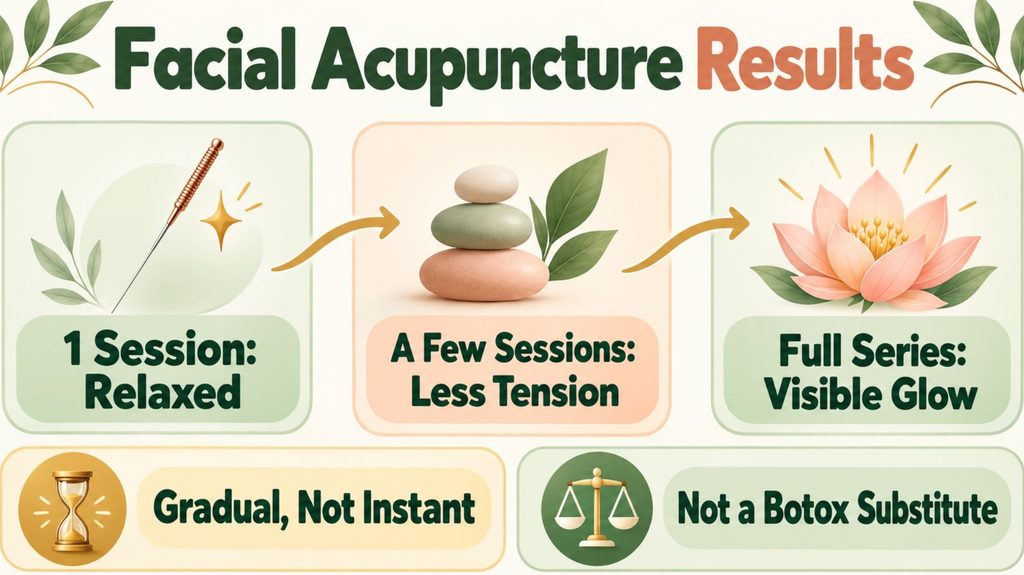
It helps to think of this in stages rather than expecting one dramatic before-and-after moment.
After a single session, most people notice a sense of relaxation and maybe a temporary glow, nothing lasting yet. After a few sessions, subtler shifts tend to show up, slightly less tension, a bit more ease in the face. After a full series, that’s usually when the more noticeable cumulative changes tend to show, though exactly how many sessions that takes varies by person and is worth discussing directly at your consultation rather than assuming a fixed number.
Are Before-and-After Photos Trustworthy?
Honestly, it depends. Good before-and-after photos should be unedited, taken in the same lighting, same angle, same time of day, with the person’s written consent to share them. A lot of what circulates online doesn’t meet that bar, different lighting, different expressions, sometimes even different people. It’s fair to ask any practice how their photos were taken before trusting them.
Why Facial Work Pairs So Well With Whole-Body Acupuncture
Here’s something that doesn’t get said enough: your face is connected to the rest of you. Stress, poor sleep, and hormonal shifts all tend to show up there eventually, in tension, in puffiness, in that tired look that concealer can’t quite fix. That’s part of why facial sessions are often woven into a bigger-picture approach rather than treated as a standalone cosmetic add-on.
If sleep has been part of the picture, or if hair thinning has been on your mind too, those often connect back to the same root causes that show up on your face. Looking at the whole-body approach to acupuncture can give you a fuller picture of how it all fits together.
Who This Suits, and Who Should Check First
Facial acupuncture tends to be a good fit for people curious about a gentler, more gradual approach to how their face looks and feels. That said, a few situations call for a conversation first: pregnancy, bleeding disorders or blood-thinning medication, an active skin infection, or very recent fillers or Botox in the area. If any of that applies to you, just mention it before booking so your session can be adjusted accordingly.
Side Effects and Downtime

The most commonly reported side effects are small, mild bruising, a bit of redness, maybe some brief tenderness where the needles were. Most people don’t need any real downtime afterward. If anything feels off or doesn’t settle within a day or two, that’s worth mentioning to your practitioner.
Cost and How Many Sessions
Pricing and the typical number of sessions vary depending on your goals and what you’re hoping to address, so this is best discussed directly during a consultation rather than assumed from a general number online.
What Clients Often Share
A pattern that comes up a lot with facial work: people come in curious about one specific thing, maybe puffiness, maybe tension around the jaw, and end up noticing that the sessions themselves, the slowing down, the quiet, matter almost as much as whatever shows up on their face afterward.
This reflects a general pattern seen across clients, not any one specific story or promised outcome. Every face, and every person, responds a little differently.
Curious Whether This Is Right for You?
Wanting to know what you’re actually getting into before spending money on anything, that’s a completely reasonable thing to want, not something to feel silly about. If you have questions, they’re welcome, no pressure to commit to anything right away.
Book a consultation or text Winnie at 626-642-8993.
Frequently Asked Questions
The evidence is mixed. Some small studies show promising changes in skin elasticity, while at least one case series found no significant improvement in wrinkles. It seems to work better as a gradual, cumulative process than a guaranteed fix.
Most people describe it as a mild prick or tingling sensation. Some mild bruising or tenderness afterward is possible but usually minor.
Research on this specific question is limited, so it varies quite a bit by person and by whether you continue with occasional maintenance sessions.
Not exactly. It’s a different approach with a much smaller body of evidence behind it, so it’s worth thinking of as its own option rather than a direct swap for Botox or fillers.