
Quick answer: There’s no single number that works for everyone. How often acupuncture makes sense depends on what’s being treated, how long it’s been around, and how the body responds along the way. Most people start with sessions closer together, usually once or twice a week for a stretch, then space things out as symptoms ease, eventually settling into something more occasional for maintenance.
- Acute issues, like a recent strain or flare-up, often settle faster with a short run of closely spaced visits
- Chronic or long-standing concerns usually need a longer runway before frequency starts to drop
- Stress and anxiety can shift surprisingly fast for some people, though lasting change tends to take a bit more time
- Once things stabilize, care often shifts to something occasional, more about staying ahead of symptoms than chasing them
- The right rhythm is something that gets figured out together, not handed down as a fixed rule
Introduction

If you’re asking how often you should get acupuncture, you’re not alone. It’s one of the most common questions that comes up before a first visit, and honestly, “it depends” is the truthful answer. What it depends on is worth unpacking, because it changes everything about how a treatment plan takes shape. Research on acupuncture for generalized anxiety, for example, has found that a treatment window of roughly four to six weeks tends to produce better outcomes than shorter courses, which is a useful data point, not a rule that applies to every condition or every person. Here’s what actually goes into figuring out your rhythm, what the first few weeks tend to look like, and how you’ll know when it’s time to space things out.
What Actually Decides How Often You Need Acupuncture
A few things shape the answer here, and they matter more than any general guideline floating around online.
Acute versus chronic. A recent injury or sudden flare-up tends to respond to a shorter, more concentrated course of care. Something that’s been building for months or years usually needs more time and more consistency before real shifts show up.
How long the issue has been present. The longer a pattern has had to settle in, whether that’s tension, pain, or a sleep issue that’s dragged on for a year, the more sessions it tends to take to unwind.
Age and general health. Two people with the same complaint can respond at very different speeds depending on overall health, stress load, and how the body tends to recover.
Stress levels and daily habits. What happens between sessions matters almost as much as the session itself. Sleep, movement, hydration, and stress all influence how long relief tends to last and how quickly progress builds.
What the actual goal is. Pain relief, stress management, fertility support, hormonal balance, or general maintenance all call for different starting points and different timelines.
None of these factors work in isolation. A practitioner weighs all of them together before suggesting a starting rhythm, and that rhythm should feel like a conversation, not a script handed over on day one.
A Typical Starting Rhythm, By Goal
While exact numbers vary person to person, most treatment plans follow a similar shape depending on what’s being addressed:
| Goal | How it usually starts | How it usually shifts over time |
| Acute pain or recent injury | Closer together at first, to build momentum while things are still fresh | Spaces out fairly quickly once relief starts holding between visits |
| Chronic pain | A steadier, more sustained rhythm | Tapers gradually as progress becomes more consistent |
| Stress, anxiety, and sleep | Can respond within just a few visits for some people | Often shifts to a lighter, ongoing rhythm once a baseline of calm sets in |
| Hormones and cycles | Tends to follow a longer arc, often timed with cycle phases | Settles into a steady, less frequent pattern once things regulate |
| Seasonal or maintenance care | Occasional visits timed around seasonal shifts or stress spikes | Stays light touch, more preventive than reactive |
If a back issue sounds like what’s going on, there’s more detail on acupuncture for back pain. Sleep struggles have their own page too, over at acupuncture for insomnia, and anyone navigating hormonal shifts can find more in the piece on menopause and perimenopause acupuncture.
Why the First Few Visits Tend to Be Closer Together
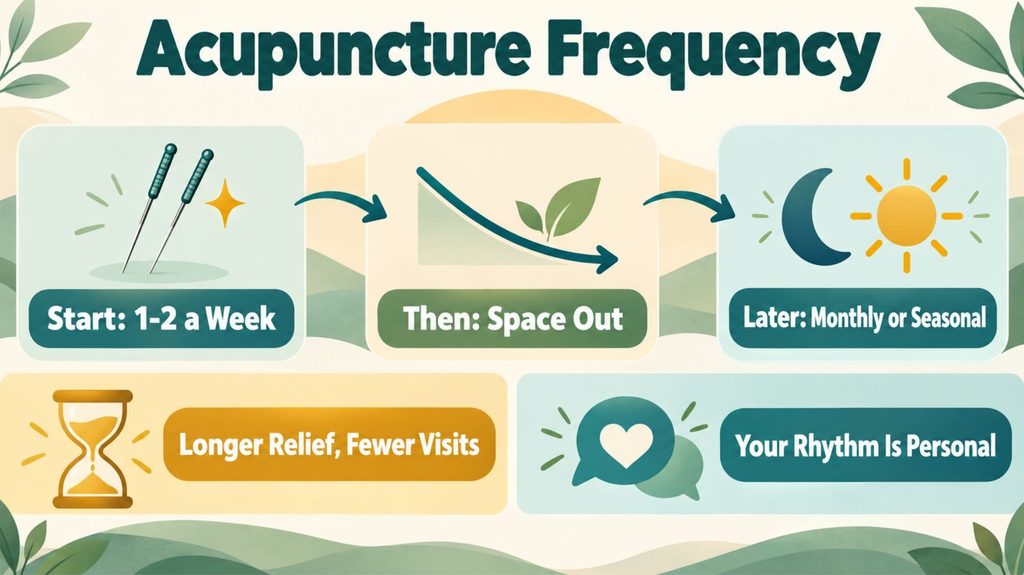
There’s a reason early sessions are usually scheduled closer together rather than spread out from the start. The effects of acupuncture tend to build cumulatively. One session can bring real relief, but that relief often fades faster than it will later on, once the body has had a chance to respond to a few rounds of treatment. Spacing sessions closer together early on helps momentum build before things start to space out naturally.
This isn’t about needing more treatment than necessary. It’s closer to how physical therapy or strength training works: consistency in the beginning tends to matter more than any single session, and the gains tend to compound rather than reset between visits.
How You’ll Know It’s Working
Progress with acupuncture isn’t always dramatic, and it’s rarely instant across the board. What tends to shift, gradually, is a combination of things worth paying attention to:
- Pain levels, both at rest and during activity
- Sleep quality and how easy it is to fall or stay asleep
- Overall mood and stress tolerance
- Energy throughout the day
- How long relief from each session tends to last before symptoms creep back
That last one is often the clearest signal. When relief starts sticking around longer between visits, that’s usually the cue that frequency can start to ease back. This kind of tracking is part of what shapes the ongoing plan, the same step-by-step approach woven through the rest of the care journey here.
Can You Get Acupuncture Too Often?
It’s a fair question, and the honest answer is yes, there’s a point of diminishing returns. The body needs time between sessions to actually process and respond to treatment, and piling visits too close together doesn’t necessarily speed things up. If sessions start feeling less effective, or something feels a bit off afterward, like unusual fatigue or soreness that lingers, that’s worth mentioning at the next visit. A good plan leaves room to listen to how the body is actually responding, not just follow a calendar.
Does a Longer Treatment Plan Mean Something’s Wrong?

This is a question that doesn’t get addressed honestly very often, and it deserves to be. A longer course of care doesn’t mean something’s gone sideways, and it definitely isn’t a sign of being upsold. Some conditions, especially ones that have been around for a while, genuinely need more time to shift. What matters is whether the plan is actually getting reviewed along the way. Progress should be checked in regularly, frequency should adjust as things change, and there should always be a clear sense of why a particular rhythm is being recommended at any given point. If a plan ever feels vague or unexplained, that’s worth asking about directly.
Putting It Into Practice
A few things tend to make the early stretch of care go more smoothly:
- Expect the first few visits to feel a little different from later ones, as the practitioner gets a clearer picture of how the body responds
- If a schedule isn’t realistic financially or logistically, say so. Plans can usually be adjusted without losing momentum
- Pay attention to how long relief lasts after each visit. That single detail tells you more about pacing than almost anything else
- Consistency early on tends to matter more than perfection. Missing an occasional session isn’t a setback, but long gaps in the early weeks can slow things down
A Quick Word on Safety and Expectations
Acupuncture is generally well tolerated, and serious side effects are uncommon when sessions happen with a licensed, trained practitioner. That said, it isn’t a guaranteed fix, and results genuinely vary from person to person. Some people notice shifts quickly, others need more time, and that range is normal rather than a sign anything is wrong.
The Bottom Line
Frequency isn’t something to figure out from a chart online. It’s a conversation that starts with where things stand right now and adjusts as the body responds. Starting with more frequent visits and tapering from there is common, but the actual pace is personal.
Not sure what your plan should look like? Book a first visit, and Winnie will map it out with you.
Frequently Asked Questions
It depends on the condition and how long it’s been present, but many people notice some shift within the first several sessions, with fuller results building over a few weeks of consistent care.
For many people, yes, especially in the early stretch of a treatment plan. Weekly visits are a common starting rhythm before spacing out as symptoms ease.
Once a condition has stabilized, maintenance care is often monthly or seasonal, more about staying ahead of symptoms than reacting to them.
Sessions typically run somewhere between 45 minutes to an hour, including time to talk through how things have been since the last visit.