
Quick answer: Feeling disconnected from yourself can happen when chronic stress, burnout, grief, or overwhelming emotions leave your nervous system in a protective, shut-down state. This can feel different from loneliness, and it usually responds better to genuine rest, nervous-system regulation, and safe human connection than to simply trying harder or “thinking positive.”
- Disconnection can be a protective nervous-system response rather than a personal failing.
- It is different from loneliness, although the two can overlap.
- Willpower alone is often limited when the body is still carrying stress or overwhelm.
- Rest that helps the nervous system settle, together with a safe and supportive community, can help restore a sense of connection.
- Persistent, severe, or worsening disconnection, especially when accompanied by depression, anxiety, trauma symptoms, or difficulty functioning, deserves professional evaluation and support.
Introduction
There is a particular kind of tiredness that has nothing to do with sleep. It shows up as going through an entire day, a whole conversation, or even a favorite activity, and feeling strangely absent from it. Like watching life happen from a few steps behind glass instead of standing inside it.

This is one of the most common things clients describe at Mindful Healing Heart, and it deserves a straight answer rather than vague reassurance. Feeling disconnected from yourself is most often the nervous system’s response to prolonged stress, unprocessed emotion, or burnout. It is a protective shutting-down, not a personal failing. This article looks at what actually causes it, how it differs from loneliness, why trying harder rarely fixes it, and what genuinely helps, starting with rest and moving into community.
What Does It Mean to Feel “Checked Out” From Your Own Life?
Feeling checked out can look like moving through familiar routines on autopilot, making dinner without really tasting it, sitting through a conversation while your mind drifts somewhere else, or feeling as though you are physically present but emotionally far away.
Emotions that once felt vivid and immediate may begin to feel muted, distant, or harder to access, almost like watching the color slowly fade from a photograph.
For some people, this sense of disconnection is temporary and linked to stress, exhaustion, grief, or overwhelm. For others, it can be a sign that the nervous system has been working hard to protect them for a long time.
This experience exists on a spectrum. For some people, it may show up as an occasional off day and pass by the next morning. For others, it can become a more persistent pattern that lasts for days or weeks.
At the more intense end of that spectrum are experiences such as depersonalization and derealization, in which a person may feel detached from their body, thoughts, emotions, or surroundings, or describe the world as unreal, distant, or dreamlike.
If that sense of disconnection becomes intense, persistent, or begins to interfere with daily life, seeking a professional evaluation is a reasonable and supportive next step, not a last resort.
What Causes You to Feel Disconnected From Yourself?
Can chronic stress make you feel disconnected?
Yes. Chronic stress can keep the nervous system in a prolonged state of vigilance, asking the body to stay alert and responsive for far longer than is comfortable or sustainable.
Over time, some people begin to experience emotional blunting, detachment, or a sense of “checking out” as the brain and nervous system adapt to ongoing overwhelm.
This response can be understood as a protective strategy rather than a personal weakness, the system may be reducing the intensity of what you feel when there has simply been too much to process for too long.
Why does caregiving or constant responsibility lead to disconnection?
Ongoing responsibility for others, through caregiving, parenting, or a demanding job that never fully switches off, can leave very little space to notice your own internal state.
Disconnection often develops quietly in this context. Rather than one dramatic moment, it can emerge through the gradual accumulation of always tending to everyone and everything else first, until your own needs, emotions, and body signals become harder to hear.
What happens when emotions get suppressed for too long?
Emotions that are repeatedly pushed aside do not always disappear; over time, some people begin to experience a broader sense of emotional flattening or disconnection.
That can feel very different from genuine calm.
Numbness is the absence of feeling. Calm is the presence of ease.
What is nervous system dysregulation, and how does it relate to all of this?
The nervous system is constantly helping the body interpret whether it is safe, challenged, or under threat. When stress keeps the system in a prolonged state of hyperarousal or shutdown, it can become harder to feel present, connected to yourself, and available for connection with others.
This is a physiological state rather than a personality trait, and understanding it that way can change how we approach healing. For a deeper explanation of how regulation works and what can support it, see our nervous system regulation guide.
Is Feeling Disconnected the Same as Feeling Lonely?
No. Loneliness is the felt absence of meaningful connection with other people, while disconnection from yourself is the felt absence of connection with your own thoughts, emotions, or body.
The two often overlap, but they are distinct experiences and may respond to different forms of support. Someone can feel lonely while still feeling deeply connected to themselves, or feel disconnected internally even when surrounded by people they care about.
| Loneliness | Disconnection from self |
| Felt absence of meaningful connection with others | Felt absence of connection with one’s own thoughts, feelings, or body |
| Can improve simply by spending time with the right people | Can persist even in the presence of caring people |
| Often tied to circumstance: distance, life stage, isolation | Often tied to nervous-system state: stress, burnout, suppressed emotion |
| Eases with genuine social contact | Eases with nervous-system regulation first, community second |
Someone can feel completely disconnected from themselves while surrounded by people who love them. And someone can feel lonely while still feeling entirely present within their own body. Knowing which one is actually happening changes where to start looking for relief.
Why Doesn’t Willpower Alone Fix Feeling Disconnected?
Because disconnection can involve the nervous system as much as the thinking mind. Simply telling yourself to “snap out of it” asks conscious thought to override a protective physiological response, which often has limited effect and can add frustration or self-criticism to an already difficult experience.
A useful analogy is a smoke alarm: asking it to stop beeping without addressing what triggered it rarely solves the problem. In the same way, meaningful change often comes from helping the body experience greater safety and regulation through rest, movement, breath, supportive relationships, therapy, and other appropriate forms of care, rather than relying on willpower alone.
What Are Practical Ways to Reconnect With Yourself?
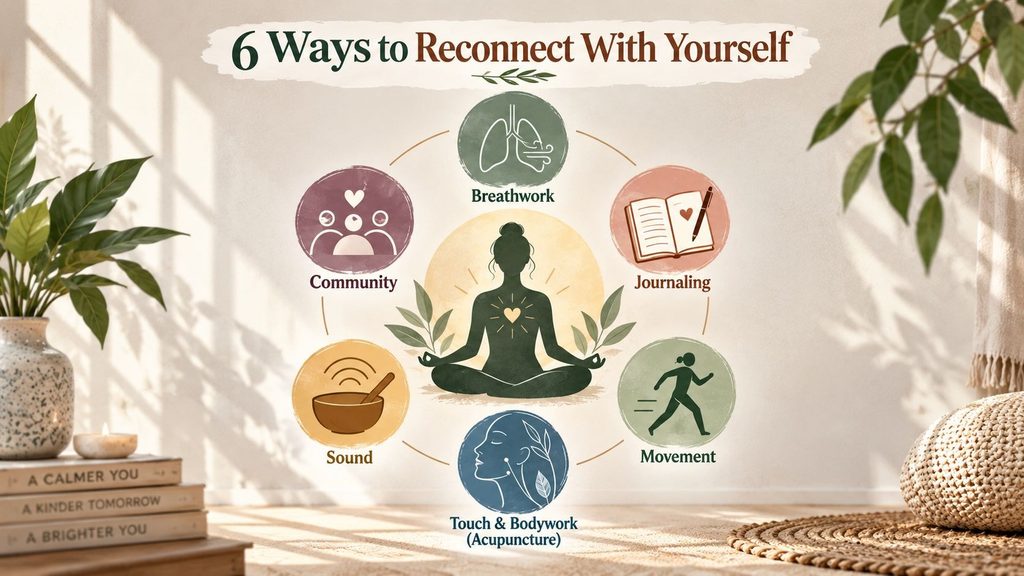
1. Breathwork. Slow, intentional breathing can help the nervous system shift toward a calmer state. Even a few minutes of gentle breathing, particularly with a comfortable, slightly longer exhale, may help reduce tension and bring attention back into the body.
2. Journaling. Writing thoughts and emotions down without immediately judging or editing them can create space around an overwhelming experience. Over time, journaling may also help reveal patterns, needs, or feelings that were difficult to recognize in the moment.
3. Movement. Gentle, supportive movement such as walking, stretching, or Qigong can help restore awareness of physical sensations and reconnect you with the experience of being present in your body.
4. Touch and bodywork, including acupuncture. For some people, therapeutic touch and body-based practices provide another pathway toward relaxation and nervous-system regulation. Acupuncture may help support stress and anxiety management by influencing physiological systems involved in arousal, relaxation, and the stress response. Our detailed guide to acupuncture for anxiety in Pasadena explains how we use this approach in practice. Acupuncture can complement professional mental-health or medical care when those services are appropriate.
5. Sound. Calming or grounding sound, including music, humming, chanting, or guided audio, can offer an accessible way to shift attention and internal state. This can be especially helpful for people who find complete silence difficult or activating.
6. Community. Safe, supportive connection with another person can help restore a sense of presence, belonging, and emotional connection. Sometimes simply being seen, heard, or accompanied, without having to explain or fix everything, can make it easier to feel grounded in yourself again. Because this kind of connection can play such an important role in healing, it deserves a closer look.
Why Does Reconnection Feel Different When It Happens in Community?

Our nervous systems are influenced by the people around us. This is often described as co-regulation: being with someone who feels calm, present, and attuned can make it easier for our own system to settle, especially when we are feeling activated, overwhelmed, or shut down.
There is also something powerful about being witnessed. Naming a feeling out loud to someone who listens without judgment can create a sense of relief, validation, and connection, helping an experience feel more manageable and less isolating.
In practice, many clients describe arriving with this same sense of feeling checked out or disconnected. For some, combining nervous-system-focused care with safe, low-pressure community connection can support a fuller sense of reconnection than either approach alone.
Is There a Local, Low-Pressure Way to Practice This?
If you’re looking for a gentle way to support your nervous system while connecting with others, Mindful Healing Heart offers several welcoming opportunities in Pasadena. Whether you prefer one-on-one care or a community setting, you’ll find spaces designed to help you slow down, reconnect, and feel supported, without any pressure to share more than you’re comfortable with.
You might choose a personalized acupuncture and Reiki session with Dr. Winnie Chan Wang, join the weekly Midweek Healing Circle for women, or experience a Tao Calligraphy Light Wall or Light Shower class, where guided meditation, breathwork, gentle movement, and healing practices create a calming environment for nervous system regulation. Every offering is designed to meet you where you are, whether you’re seeking relief from chronic stress or simply looking for a place to pause and recharge.
Healing doesn’t require perfection or performance. Sometimes it begins by simply showing up and allowing yourself the space to rest.
Finding Your Way Back to Yourself, One Step at a Time
Healing rarely happens through one dramatic breakthrough. More often, it unfolds through small, consistent moments of safety, each one gently reminding the nervous system that it no longer has to stay in survival mode. Over time, those moments begin to build on one another, helping you feel calmer, more present, and more connected to yourself.
Many people find that combining restorative practices with a supportive community creates a powerful foundation for lasting well-being. Whether that means personalized acupuncture and Reiki, joining a healing circle, or simply giving yourself permission to slow down, each step can become part of a healthier relationship with your body and mind.
If you’re ready to explore a whole-person approach to nervous system regulation, Mindful Healing Heart offers personalized acupuncture, Reiki, and welcoming community programs in Pasadena designed to support healing with compassion and without pressure. Wherever you are on your journey, Dr. Winnie Chan Wang would be honored to help you take the next step, at a pace that feels right for you.
Frequently Asked Questions
1. Why do I feel disconnected from myself?
Feeling disconnected from yourself is often the nervous system’s way of protecting you during periods of prolonged stress, burnout, grief, or emotional overwhelm. Rather than staying in a constant state of high alert, the brain and body may begin to numb emotions or create a sense of distance from your thoughts, feelings, or surroundings. This can leave you feeling as though you’re simply going through the motions instead of fully experiencing your life. It’s a common human response, not a personal weakness, and many people find that practices supporting nervous system regulation, self-compassion, and safe connection with others can help them gradually feel more present, grounded, and connected again.
2. Why do I feel disconnected from everyone around me?
Feeling disconnected from others often reflects the same nervous system patterns that can leave you feeling disconnected from yourself. During periods of chronic stress, burnout, grief, trauma, or prolonged emotional strain, the brain and body may become more focused on protection than connection, making it harder to feel present even with people you care about. Extended isolation, major life changes, or excessive time spent online can also contribute to this sense of distance. Rebuilding connection rarely happens all at once. It often begins with small, low-pressure moments of genuine human interaction, supportive community, and practices that help the nervous system feel safe enough to reconnect with both yourself and the people around you.
3. Is feeling disconnected the same as being lonely?
No. While the two often occur together, they are not the same. Loneliness is the feeling of lacking meaningful connection with other people, whereas feeling disconnected from yourself is the sense of being out of touch with your own thoughts, emotions, or body. It’s possible to feel lonely while still feeling grounded within yourself, and it’s equally possible to feel emotionally disconnected even when surrounded by supportive family and friends. Both experiences can improve with time, nervous system support, self-awareness, and opportunities for genuine, safe connection.
4. How do I reconnect with myself?
Reconnecting with yourself is usually a gradual process, not a single breakthrough. Practices such as mindful breathing, journaling, gentle movement, meditation, time in nature, and body-based therapies like acupuncture can help calm the nervous system and create space to notice your thoughts, emotions, and physical sensations again. Many people also find that healing happens more easily in the presence of safe, supportive relationships. Whether it’s one trusted friend, a therapist, or a compassionate community, feeling seen without pressure to perform or explain everything can be a powerful step toward feeling like yourself again. At Mindful Healing Heart, Dr. Winnie Chan Wang supports this journey through personalized acupuncture, Reiki, and community healing experiences that help people reconnect with themselves one gentle step at a time.
5. When should I see a professional about feeling disconnected?
If your sense of disconnection is persistent, becoming more intense, or making it difficult to work, maintain relationships, or enjoy daily life, it’s important to seek professional support. You should also speak with a healthcare or mental health professional if you feel detached from your body or surroundings (sometimes called depersonalization or derealization), or if your symptoms are accompanied by significant anxiety, depression, panic attacks, or trauma-related distress. If you are experiencing thoughts of harming yourself or feel that you may be in immediate danger, seek emergency assistance or contact a crisis service right away. Reaching out for help is a sign of strength, and many effective treatments and supportive resources are available.